


#34 Suggested Repertoire from Around the World for Developing Bands
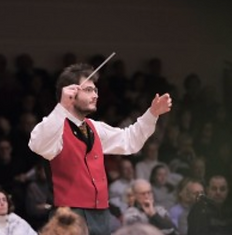
This 34th installment of suggested repertoire is proposed and curated by Fabio Turra an Italian conductor based in Trento. He is currently active in the Trentino region, where he directs three wind bands of different levels, working closely with musicians ranging from emerging players to more experienced ensembles.
Grade 2
Marcia dei Bambini (2000) – 4'15" – Purchase at Edizioni Eufonia
Claudio Palli (Italy, 1952)

Marcia dei bambini is an original piece for recorders and Wind Band, based on five basic notes of the recorder (G, A, B, C, D), with an accessible and catchy melody. The solo part, played by the recorder, offers great flexibility: it can be performed by a single soloist or by a choir of recorders playing in unison. It can also be transposed for many Wind Band instruments, making it very versatile. This feature makes the piece a valuable resource for introducing new members or encouraging young musicians to join the Wind Band.
Although not an extremely recent composition, Marcia dei bambini fits perfectly into modern
educational contexts such as recent projects that propose the use of plastic band instruments in the key of C, suitable for children, precisely to introduce lower-level students to the instrument and to the Band, facilitating integration and intuitive learning.
The structure of the piece is the classic march form, with simple and immediate writing and melody, despite the key is G major. It is a piece that is well suited, also in terms of instrumentation, to a youth band, i.e. a first-level band.
Claudio Palli is a so-called “child of art”, having inherited his passion for music from his father, who was for many years concertmaster of the orchestra at the Carlo Felice Theatre in Genoa. Palli has worked extensively in music schools and educational contexts and therefore knows young people and their first approaches to music very well, especially in the Italian context. Although he isn’t widely known, this composition reflects his innovative educational vision. With an eye to the future, this work is specifically designed to introduce children to the world of the band, providing an accessible and engaging musical bridge between play and instrumental learning.
Grade 2.5
Postcards from Tomorrow (2021) – 7' – Purchase at FC Music Publishing
Gauthier Dupertuis (Switzerland , 1997)

Gauthier Dupertuis is a young Swiss composer and conductor with a fresh, modern yet accessible approach. His academic background is solid and diverse: he holds a Master's degree in Musicology and Philosophy from the University of Fribourg and studied conducting at the renowned Haute École de Musique in Lausanne and the Bern University of the Arts, honing his skills with world-renowned masters. Dupertuis is a versatile artist, regularly invited as a guest conductor, consultant and jury member in international competitions. His growing reputation as a composer has been consolidated by important international awards and prizes. His works are appreciated for their ability to combine refined sound research with musical solutions of immediate impact. Leading composers and conductors, such as Franco Cesarini and Edward Gregson, have praised his vibrant and luminous orchestrations, which give his compositions a richness of colour and dynamism capable of captivating every listener.
Grade 3
Ford's Machine (2011) – 10’00” – Purchase at HaFaBra Music
Jess Langston Turner (USA, 1983)

Ford's Machine is a vibrant celebration of American revolutionary ingenuity, embodied by Henry Ford, the inventor of the assembly line and the famous machine that still bears his name today.
The piece opens with a fanfare based on the musical motif derived from the name “FORD”
(F-Do-Re-D), which accompanies the entire piece. This opening fanfare beautifully encapsulates the American spirit, bringing to mind Aaron Copland's famous Fanfare for the Common Man.
The subtitle of the second section, “Assembling the Machine”, reveals the composer's programmatic intent. Here, by progressively adding more and more instruments with different rhythms, “assembles” the theme. The music in this section is highly descriptive: sounds grind, clatter and beat incessantly, driven by the relentless hammering of the percussion, which recreates the relentless rhythm of industrial production. Furthermore, this movement makes extensive use of fourths and fifths, making it an excellent exercise for intonation - a characteristic that truly defines the entire piece, as dissonant chords, always constructed using fourths and fifths, recur frequently.
The next section, Ford's America, is characterised by a swing style, making the piece an excellent opportunity to introduce and study different styles and sound contrasts: the opening fanfare, a more rhythmic and vertical second movement and a swing section. The piece ends with a coda that reprises the theme of the second section, finally closing in a full circle with a brass chorale (a reference to the opening fanfare), which again features overlapping chords, thus creating an almost polytonal effect.
Jess Langston Turner is an American composer of instrumental and choral music, known for his infectious energy and ability to create vivid soundscapes. His music is a powerful blend of rhythmic inventiveness and captivating melodies, often drawing inspiration from historical events or high-impact concepts. He studied at Bob Jones University, the Hartt School at the University of Hartford, and Indiana University, and has received numerous prestigious awards for his works. Turner has also been composer-in-residence at many universities and high schools in the United States. He has a remarkable ability to fuse vigorous rhythmic elements with memorable melodic passages, making his pieces dynamic and rich in contrast.
Grade 3
Sang! (1994) – 4' – Purchase at Ludwig Misic
Dana Wilson (USA, 1946)

In Sang!, rhythm is the absolute protagonist. The work opens with a phrase chanted by the entire band: ‘Sang! Sang! ooh-ga-ka-tang!’, which becomes the rhythmic and melodic foundation of the entire piece. This opening phrase is not static: it is repeated by various instruments throughout the piece, often broken up, overlapped and combined in its parts to create a sense of intensity and sonic growth. Given the rhythmic difficulty of the phrase, it is possible, as the composer himself suggests, to teach students only by rhythmic sound rather than immediately introducing musical notation, which can be brought in later. This type of approach is useful for learning very natural rhythms, often found in popular music but difficult to write down. It is also useful for building the piece, as everyone listens to the parts of the other instruments and learns complex rhythmic configurations using the ancient and intuitive technique of singing “by ear”.
Within the composition there is also scat singing, both in unison and in canon, a historical technique of African-American music, which has proved very useful for working on more incisive articulation and phrasing, contributing to the development of greater expressive precision in the ensemble.
Of course, in a work where rhythm is central, percussions play a fundamental role. Often supporting the main thematic line, but sometimes contrasting with it, percussions not only enrich the sound palette, but also gives great importance and visibility to the Wind Band's rhythm section.
Dana Wilson is an American composer whose music is intrinsically didactic, designed to expand students' technical and musical abilities in a fun and stimulating way. His career is linked not only to composition but also to teaching, having been a professor of composition for many years at the prestigious Ithaca College in New York, where he is now professor emeritus.
Wilson is recognised for his eclectic style, masterfully blending classical influences with elements from jazz, blues and popular music. His works for Wind Band are famous for their rhythmic innovation and ingenious use of sonority, which often challenge conventions and actively involve the performers through unconventional techniques, such as direct vocalisation or the exploration of new timbres from instruments, as in Sang!
Grade 4
Riften Wed (2013) – 7'23" – Purchase at Musica Propria
Julie Giroux (USA, 1961)

Riften Wed is a profound and evocative composition inspired by the video game Skyrim, which is very popular among young people. The distinctive feature of the piece is its slow and meditative nature, which translates into considerable agogic freedom. This characteristic offers the Wind Band an exceptional opportunity to refine their control of dynamics and phrasing.
The frequent changes in metre, linked to the slow and contemplative character of the piece, represent a stimulating challenge for both the musicians and the conductor, who must guide the ensemble with precision through the transitions, helping to create the delicate and changing sound texture.
In addition, there are parts in which only one section plays, offering valuable moments for focused work aimed at improving phrase intention and, especially, intonation.
Proposing a piece inspired by a universe as well-known and beloved as Skyrim helps musicians internalise the intention and fluidity of the phrases, allowing them to connect more deeply with musical expression.
It also allows the Wind Band to develop musical sensitivity, agogic precision and the ability to create a cohesive, deep and in-tune sound.
Julie Giroux is one of the most celebrated and influential figures in contemporary music, recognized globally for her versatility and compositional mastery. Her career is an impressive fusion of the worlds of Hollywood and Wind Band music.
Her training saw her study composition with giants such as John Williams, Bill Conti and Jerry Goldsmith; she has collaborated with world-renowned artists, producers and celebrities, from Martin Scorsese to Michael Jackson, demonstrating a rare versatility. She was the youngest woman to win three Emmy Awards in her category.
She then devoted herself to Wind Band music, becoming one of the most prolific composers with over 200 original pieces. With a deep melodic sensibility and masterful orchestration, Julie Giroux's pieces always manage to move me.
Grade 5
Saxa Picta (2021) – 12'30" – Purchase at Scomegna Edizioni Musicali
Luciano Feliciani (Italy, 1973)

Saxa Picta, literally painted rocks, by Italian composer Luciano Feliciani, draws inspiration from the cave paintings of Lascaux, among the earliest and most fascinating examples of human art. The piece transports the listener to a primordial soundscape, where ancestral rhythmic pulsations and instrumental counterpoints generate a profound sense of awe and wonder, similar to what one feels when entering these painted caves, outside of time.
The composition opens with a bubbling percussive magma, dominated by polyrhythms and frequent tempo changes (13/8, 11/8, 4/4...), evoking a primal, pulsating energy. Thematic fragments entrusted to the various instrumental groups are grafted onto this rhythmic material, overlapping and developing into a dense counterpoint, gradually building the musical core of the piece.
The central section, slower and more ethereal, is characterised by harmonic overlaps,
refined timbres and a suspended expressive theme, evoking contemplation, wonder and
the mystery of these universal works of art. The return to the initial pulse finally leads to
the grand and spectacular coda, in which the previous materials converge in a climax of
strong sonic impact.
Saxa Picta represents a challenge for both the ensemble and the conductor. The
numerous key changes, complex textures and technically demanding writing — particularly for the woodwinds — require a high level of instrumental control. Sound balance,intonation control and timbral colour management are also particularly delicate, especially in the opening and closing sections, where the rhythmic and sonic density can easily turn into noise if not guided by the conductor's careful gestures.
Thanks to its evocative power, the central role of percussion and the richness of its writing,Saxa Picta stands out as a significant contribution to the contemporary band repertoire,capable of enhancing advanced ensembles and deeply engaging performers and audiences alike.
Luciano Feliciani is an Italian composer and conductor. After graduating in trumpet from
the G. Rossini Conservatory in Pesaro, he went on to study composition, conducting and
film music, collaborating with leading figures such as Nicola Piovani and Luis Bacalov. In
the field of wind band music, he trained with some of the leading international composers and conductors for wind orchestra.
His compositions for wind bands and chamber music have been published by major
international publishers, recorded by renowned wind orchestras and selected as
compulsory pieces in international competitions. He is also active as a conductor and
teacher, with a particular focus on teaching and contemporary repertoire for wind.


