


SEPTUOR D’INSTRUMENTS à VENT, Op.165 for Chamber Winds by CHARLES KOECHLIN (France, 1867 – 1950)
[#341] Feb 02, 2026
France | 1937 | Wind Septet | Grade 5 | 14' | Chamber Winds
Premier conducted by Paul Collaer on March 17, 1943
at National Institute of Broadcasting, Brussels
This piece is available for purchase at Accolade
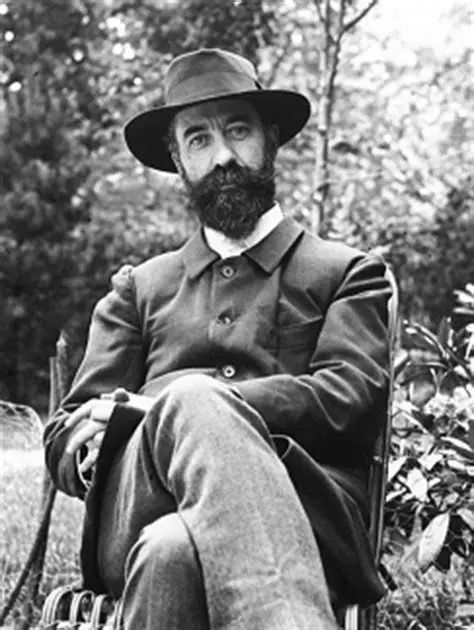
Septuor d’instruments à vent Op. 165 by French composer Charles Koechlin is our Composition of the Week.
The Septet for Wind Instruments was composed between June and August 1937, and completed during one of Koechlin’s tours in the United States.
The work, dedicated to Paul Collaer, was premiered under the direction of its dedicated in Brussels on 17 March 1943 at the National Institute of Broadcasting.
Written for flute, oboe, English horn, clarinet (in A), alto saxophone, bassoon, and horn, it originally bore the title “Caprice on the Return of My Son.” Charles Koechlin was referring to his son Yves, who was fifteen years old at the time and had run away from home.
This event inspired, among other things, a musical fugue and a movement titled “Serenity,” imbued with the joy of his son’s return.
The septet seems to have occupied the composer’s attention for quite some time, as he produced a version for 14 instruments in the same year as the composition of the original version, though only up to the Finale.
The composer also made, in 1945, a transcription of the septet for wind octet, with flute, English horn, A clarinet, C clarinet, basset horn, bass clarinet, bassoon, and horn, intended for the Gaston Hamelin Ensemble.
In the published version of the septet, the saxophone part may also be played by a B-flat clarinet. The work has a duration of about 14 minutes and is cast in 6 movements entitled:
I. Monodie: Tranquille mais sans traîner
II. Pastorale: Tranquille et clair
III. Intermezzo: Allegretto con moto
IV. Fugue: Allegretto dolce
V. Sérénité: Calme, très doux
VI. Fugue: Allegro, animé
Charles Koechlin was born on 27 November 1867 in Paris. He married Suzanne Pierrard on 24 April 1903 and had five children.
Born into the upper industrial bourgeoisie of Alsace, Charles Koechlin was initially destined for a military career and entered the École Polytechnique in 1887. Following a serious illness, he devoted himself to music and entered the Paris Conservatoire in 1889. He studied harmony with Taudou, composition and orchestration with Massenet, composition with Fauré, and counterpoint and fugue with Gedalge.
Together with Ravel and Schmitt, he founded the Société Musicale Indépendante in 1909 to promote contemporary music. Between 1910 and 1920 he undertook a series of architectural explorations, which he realized in around fifteen chamber music works (sonatas for various instruments, quartets and quintets), as well as in several orchestral compositions: La Forêt païenne (1908), Les Saisons (1912), Three Chorales for Organ and Orchestra and Five Chorales for Orchestra (1912–1920).
Passionate about nature, he notably composed: La Forêt (1907), Spring, Winter, Summer (1908–1916), Symphony of Hymns (Prix Cressent, 1936), The Jungle Book (1939), and Landscapes and Seascapes for piano. In 1920, the composer became part of the group Les Nouveaux Jeunes, a precursor to Les Six.
Charles Koechlin also composed vocal music in a traditional style that freely employs passing tones and makes use of ancient modes: Twenty Breton Songs for cello or piano and orchestra (1931), Symphonic Fugue for orchestra (1932), Five Chorales in the Modes of the Middle Ages for orchestra (1932), Hymn for ondes Martenot and orchestra (1932), Modal Sonatina for flute and clarinet (1935), Monodic Modal-Style Choruses for Euripides’ Alcestis (1938), and Motets in an Archaic Style (1949).
The composer also wrote film music and concert works in homage to the beauty of certain stars: Lilian’s Album (1934), Seven Songs for Gladys (1935), Dances for Ginger (1937), Epitaph for Jean Harlow (1937). He also composed a large seven-part fresco, The Seven Stars Symphony (1933), evoking Douglas Fairbanks, Lilian Harvey, Greta Garbo, Clara Bow, Marlene Dietrich, Emil Jannings, and Charlie Chaplin.
With 225 opus numbers, Charles Koechlin created one of the most substantial bodies of work of his generation. He also explored the symphonic poem with Les Vendanges (1896–1906), Classical Walpurgis Night (1901–1907), Funeral Chant in Memory of Young Women Who Died (1902–1907), and Doctor Fabricius (1944). He did not neglect chamber music either, composing the Sonata for Flute and Piano (1913), Four French Sonatinas for piano four hands (1919), and his Piano Quintet (1921), which Koechlin considered “the most significant, perhaps, of my works.”
Charles Koechlin was also a teacher, and his treatises are authoritative: Studies on Passing Notes (1922), Treatise on Orchestration (1954–1959).
Alongside his career as a composer, he became especially famous as a musicologist and lecturer. In 1937, he was appointed president of the Fédération Musicale Populaire.
Francis Poulenc, Germaine Tailleferre, Roger Désormière, and Henri Sauguet were among his students. Moreover, Koechlin orchestrated Fauré’s Pelléas et Mélisande and Debussy’s Khamma.
He died in Rayol-Canadel on 31 December 1950.


