


SOLILOQUY OF A BHIKSUNI for Trumpet, Percussion and Brass Ensemble by CHOU WEN-CHOUNG (China, 1923 – 2019)
[#356] May 18, 2026
China | 1958 | Trumpet, Percussion and Brass Ensemble | Grade 6 | 5’ | Solo work
Publish and purchase at Peters
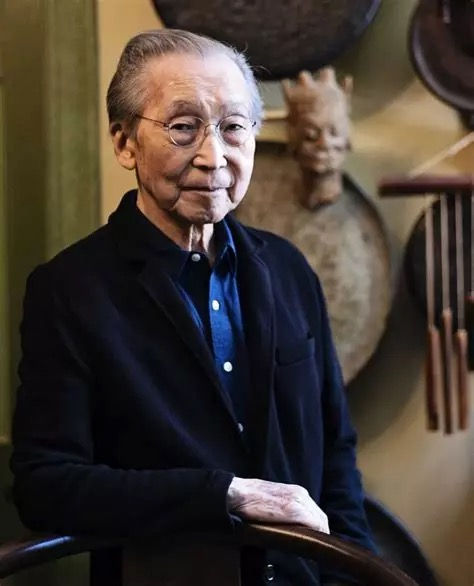
“Soliloquy of a Bhiksuni” for Trumpet, Percussion and Brass Ensemble by Chinese-American composer, pedagogue, and scholar Chou Wen-Chung, is our Composition of the Week.
Chou Wen-Choung was highly regarded for bridging Eastern and Western musical traditions, as well as for being Edgar Varèse’s student, close friend, and editor of his music.
Soliloquy of a Bhiksuni, is based on a scene from a 16th century Chinese drama. In the darkness of a Buddhist temple hall, a bhiksuni (Buddhist nun) worships before images of Buddhas and Bodhisattvas, her posture belying her thoughts:
I am only sixteen
In the early spring of Life
Yet I am thrust through
The Gate of Emptiness
Hearing only the sound of
Temple bells and ritual pipes
Striking stone chimes
Endlessly endlessly
Ringing bells
Blowing the shell trumpet
Beating drums
Trying vainly to communicate
With the Land of the Dead.
The thematic motives of this soliloquy are woven over the range of the muted trumpet and embroidered, in the brass and percussion ensemble, with sonorities that are the magnified reflexes of the brushstroke-like movements of the theme. The restrained emotion is projected and amplified by means of the same principle that marks the art of Chinese calligraphy, wherein the controlled flow of ink — through the interaction of rhythm and density, the modulation of line and texture — creates a continuum of motion and tension in spatial equilibrium.
Program notes by Chou Wen-Chung
Instrumentation
1 Solo Trumpet in B-flat (muted)
4 Horns in F
3 Trombones (1 Bass Trombone)
1 Tuba
Percussion
2 Timpani
Tenor Drum (or Field Drum senza snare)
Bass Drum (also used by 3rd player)
Triangle (with very light beater)
Tambourine (laid flat, with fingers)
Snare Drum
Suspended Cymbal (also used by 3rd player)
Suspended Cymbal (also used by 2nd player)
Gong
Bass Drum (also used by 1st player)
Chou Wen-Chung was born in Yantai, China, he originally studied civil engineering before moving to the United States in 1946 to pursue music. He studied composition at New England Conservatory and later at Columbia University, where he became a student and close associate of the avant-garde composer Edgard Varèse.
Chou’s music is known for integrating traditional Chinese aesthetics—such as calligraphic gesture, tonal inflection, and philosophical concepts—into contemporary Western compositional techniques. Notable works include Landscapes, Cursive, and Yü Ko. His style often emphasizes expressive nuance and structural clarity rather than conventional Western harmony.
Beyond composing, he played a major role in promoting cross-cultural understanding in music. At Columbia, he founded the Center for US-China Arts Exchange in 1978, fostering artistic collaboration between the two countries. He also mentored many composers, including Tan Dun.
Chou Wen-Chung is widely regarded as a pioneer of intercultural composition, helping reshape how non-Western musical traditions are understood and incorporated into modern classical music.
Other works for winds include:
• Suite for Harp and Wind Quintet (1951), 7’
• Seven Poems of the Tang Dynasty (1951/52) for chamber winds, 10’
• Metaphors (1961) Wind Symphony (for the AWSO), 17’
• Riding the Wind (1964) Wind Symphony (for the AWSO), 7’
• Yü Ko (1965) for violin, winds, piano and percussion, 5’
• Pien (1966) for winds, piano and percussion, 14’
• Ceremonial (1968) for trumpets and trombones (unpublished)
• Yün (1969) 15’
• Beijing in the Mist (1986) 12’
More on Chou Wen-Chung


